Let Your Pet Growl

Of all of the physical signals that dogs have to communicate with us, one of the most misunderstood – is the growl (cats growl too – but only in cases of aggression) Just because a dog is growling – it doesn’t necessarily mean that that is an act of aggression. There can be growling during play (with people as well as other dogs) or when your pup is barking an alert (or getting ready to alert the house). The growl can also serve as a warning signal for you to stop what you’re doing because the dog is becoming uncomfortable. The growl is one of the first lines of defense before a dog escalates to a bite.

It is very important to understand that when you (or someone, like an unsuspecting child) intrudes on a dog when they are eating, or disturbing them while they are focused on something else – they growl as a warning to create a distance between you and them (same thing with showing teeth). They are setting a boundary. It is important to honor that boundary and not reprimand them for utilizing one of the only clear lines of communication they have.

If you need to approach your pet from behind – make sure you get their attention first. In general, most pets don’t like being snuck up on. I realize that some people find this practice hilarious. Maybe some pets can tolerate it. I highly suggest against this particular practice. Remember, your pets are thinking, feeling, sentient beings who have their own thoughts and opinions about the world around them. When their boundaries are not honored or respected (basically ignored), then they will find another way of getting their point across (like snapping at you or barking).

Do you feel your pet is growling excessively and you’d like to find out why? I’d love to talk with you.


Understanding Your Pet Part 2: How to overcome these top 3 destructive behaviors..

Whenever you bring home a new furry family member, or even if you have an established animal companion - destructive behaviors and accidents can happen. In today’s post - I’ll review the top three destructive behaviors, their potential causes and what you can do to fix them.

Pet has accidents in the house: If you have adopted a rescue of any age is you will have to housebreak them. They are entering a new house and a new routine - so there may be some accidents. It’s up to you to show them where it is appropriate to go potty and to learn what your pets cue is. If your pet has been with you for years and accidents are happening - make sure the pet doesn’t have a medical cause (such as a urinary tract infection or kidney stones etc). The other thing you want to look at is how often is your pet getting exercise or play? Letting them out in the back yard isn’t enough. Ideally, taking your dog(s) on a brisk or long walk (something where they can get a good sniff at the different surroundings) will help with inappropriate elimination. For cats - make sure the litter box is clean, the cat can access it easily and it’s in a well ventilated area.

Pet is chewing things: The act of chewing can stem from a variety of reasons. If the pet is young, they could be teething. Your pet could also be bored. If your pet is bored, then get creative with the games you play - or change up the route you go on when walking. In the moment you can offer your pet something appropriate to chew and keep the things you don’t want to be chewed out of your pets reach (ex: keep shoes in bins on a high shelf or behind a closed door).

Pet is aggressive: This one is a little tricky. Is the pet guarding a resource like toys? Is the pet food aggressive? Is the aggression coming from fear? In all of these cases - if other dogs or small children are involved you need to manage the situation. If you have multiple dogs - every dog should have their own space to eat away from the other dogs. Fear can be lessened by building up your pets confidence (basic obedience training with positive reinforcement is a great start). Sometimes an aggression issue requires more in-depth work with a specialist.

Once you are in a place of understanding about your furry family member (whether they are a rescue or not) - you and your beloved pet(s) will have a long and happy life together!

Do you need help with any of the above behaviors? Schedule a free strategy session today!

Understanding Your Pet: The First Step..

“I think my pet is trying to tell me something, but I don’t know what he/she’s saying.”
“Why are they looking at me like that??”

How many times have you found yourself asking those questions? The truth of the matter is - your pets are telling you something, you’re just not able to hear them..yet. Our pets communicate with us telepathically (translation: feeling from a distance). That is - they project what they are feeling to us. We all have the ability to communicate like this as well. We just have to re-learn how to do it.

The first step is to settle down and be quiet. Stop what you are doing, take a deep breath, clear your mind of everything, and simply be calm and open. Give your pet the benefit of the doubt that they are communicating with you (more on this topic in a later blog post). For now, be quiet and simply be open. You can even say hello and see what happens. You may be surprised at what you hear! If you want to take it a step further, you can ask your favorite animal companion “What is it?” or something along those lines.

Don’t be discouraged if you don’t think you’ve heard or understood anything from your pet. Building your intuitive senses can take time - so keep practicing!

Remember to listen with the intent of listening, not with the intent to reply.

If you would like some assistance with understanding your pet feel free to contact me or schedule your free 30 minute strategy session!

**King Louie appears courtesy of his human - Karen Pierce**

Keep Bonded Pairs Together

Picture this situation. You have made the decision to adopt a pet (Congratulations!). As you research the animal rescue or shelter website, or even as you attend an adoption day – you come across a pet that you feel is the ONE. However, the pet is part of “A bonded pair”. What do you do – since you were only looking for one. You only have two options in this scenario..

Option 1: You adopt the pair and you have one more pet than what you initially planned for.

Option 2: You look for another one that is not part of a bonded pair.

Here’s why. Pets who are considered “Bonded Pairs” means that they have formed an intense emotional bond with each other. This can also mean that one pet is the eyes or ears of the other who is blind or deaf. It is critical for the well being of the pets and even for the household, that they remain together. To separate a bonded pair is asking for destructive behaviors to not only furniture – but also to themselves. In some cases, when one pet is taken away from the other – you have a lot of nervous behaviors like panting, howling, barking, searching. For my own dogs, one would get very nervous when we had both of them at the vet and one would be taken to a different room to get their shots, even if it was only for about 6 minutes.

In more extreme cases (especially when one pet is a guide for the other), the pet that was dependent on the other will inevitably be lost. One of my colleagues fosters cats for a local rescue. There was a pair of cats – one was deaf (Charlie) the other was not (Sam). Sam got adopted – but Charlie did not. So my colleague took on Charlie. My colleague did everything in her power to make Charlie feel at home. My colleague is a well seasoned cat owner and the cats that live there have an amazing home with an abundance of cuddles, playtime and attention . Yet despite all of this - plus communication that was given to this kitty – she was still profoundly sad and very heartbroken. She was grieving for her Sam – her ears to the world. Charlie was an older cat with a poor physical condition and my colleague tried everything to help her improve. After a year of Charlie being without Sam, and her physical condition not getting better – the painful but most loving decision was made to send Charlie to the Rainbow Bridge and ease her suffering.

Remember – animals are thinking, feeling, sentient beings that form emotional bonds – just like we do. To separate a bonded pair is to invite an inconsolable grief on the part of the pet and health issues that cannot be healed. Not to mention the frustration and worry that will be incurred on the part of the owner.

Bonded pairs need to remain together. They have bonded for a reason.

If you have questions about your bonded pair (or if you think you might have a bonded pair) e-mail me

*Charlie and Sam’s names are used with permission*
*Taz and Denali appear with Permission from Zehavit Kabak

Does your pet know that you’re moving?

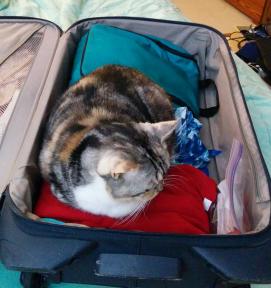
Have you ever noticed that when you are packing to leave you have that feeling of “I think my pet knows I’m going somewhere.” Think about it – if you only bring out your suitcases/duffle or weekend bags etc when you leave for a trip – of course your pets are going to know you’re leaving. Does your dog or cat hop into your suitcase every time you pull it out to start packing? While it’s a great photo opp and it’s cute to think they’re “helping”, they don’t know where you’re going and why. In this case of a vacation – the pet is left at home but you come back.

Now let me give you this scenario..

You are talking about moving. It doesn’t matter if it’s across town or across country, you are picking up everything and moving. As soon as you begin to even think about the process – your pets will pick up on your intent. In addition to talking about moving – you are of course, thinking about it. You visualize where you are going and what everything is going to look like. There’s just one small problem…

You never told your pets about the move or the intention of going anywhere.

If your pets don’t know (or don’t think they are included) about the move – then you’ll begin to see erratic behaviors. They’ll hide, they won’t act like themselves or they just seem like they are nervous. Here’s an example. Recently, I was speaking with a client who has two cats. She asked me about the one’s erratic behavior. He was racing around the house (more so than normal) and wasn’t finishing his food. My client told me she had spoken with a real estate agent that week about moving out from her current house. When I spoke to the cat in question, he felt he would be left behind (which is something of course my client would never do!). I told my client to tell him why the move was necessary and yes - he, along with the other kitty would absolutely be coming with her to the new place. He has since returned to his normal playful self of chasing his mouse toys and unceremoniously pouncing on his sister.

Cats especially tend to lay down energetic “anchors” in their territory. When they are uprooted without understanding why – you may see behaviors like eliminating outside of the litter box, or being “standoffish” when you go to give them attention.

Remember, our pets are thinking, feeling, sentient beings who understand us on a much deeper level than most people give them credit for. When you not only talk to your animal companions, but are completely honest with them in what you are talking about – they truly get it. When you communicate with your pets on this level – you will have a happier, less destructive and even stressed out pet.

Are you moving soon and need some help having your pet or pets understand why? Click here to schedule your complimentary Strategy Session

(Photo courtesy of Patty Hankins of Beautiful Flowers Pictures - Kitty Pixel is posted with permission)